Build a practical emergency plan for the first hour, the first 72 hours and the first week, with step-by-step guidance, shopping lists and printable checklists you can keep on the fridge.
The lights go out. The TV goes quiet, and so does the hum of the fridge. Through the window, the street is dark too.
Most outages like this are over in an hour or two. But for the next few minutes, you have a lot of small questions to answer, and you have to answer them in the dark.
Where's the torch? Do the batteries work?
Is it just your house, or the whole street? Should you check the fuse box first, or call someone?
Is it safe to open the freezer? How long does the food in the fridge actually last?
Your phone says 23%. Should you call your mum, or save the battery?
What about the medicine that's meant to stay cold? Or the neighbour two doors down who lives alone?
And if it's still off tomorrow morning, and the card machine at the corner shop is down too, do you have any cash in the house?
None of these questions is hard. Each one has a clear, sensible answer.
The trouble is that most of us have never sat down and worked them out in advance. So we work them out on the spot, by torchlight, with a phone that's running down.
Here's something worth knowing.
Most households are better prepared than they think. There's a torch in a drawer somewhere. A first aid kit in the bathroom. A few tins in the cupboard. Maybe a power bank from a conference.
Those things help. But a pile of supplies is not a plan.
A plan tells you what to do first. It tells you who calls whom. It tells you which food to eat first and which to throw out, how much water your household needs, and when it's time to stop waiting and go somewhere else. It's already written down, so nobody has to remember it under pressure.
That's the part most households are missing.
And it's not because people don't care. It's because the advice out there is hard to use:
What most households need is in the middle: a calm, practical plan, put in order, that you can finish in a week and keep on paper.
So we wrote one.
A practical household plan for when electricity, internet and everyday essentials stop working.
The Blueprint is a 44-page printable guide that takes your household from "we have some stuff somewhere" to "we have a plan, and everyone knows it."
It works in stages, the way real disruptions do:
Six steps, in order: check whether it's just you, make the home safe, check on people, protect your food, get official information and contact your people.
Water, food, light, communication, medication, and staying warm or cool.
How to scale up from three days to seven, plus hygiene with limited water, what to do if the toilet can't flush, food preparation and waste.
How to extend toward 30 days over time, on a budget you set, without turning your spare room into a warehouse.
Every chapter ends with a short "Do this now" box. If you only ever do those boxes, your household will be noticeably better prepared than it is today.
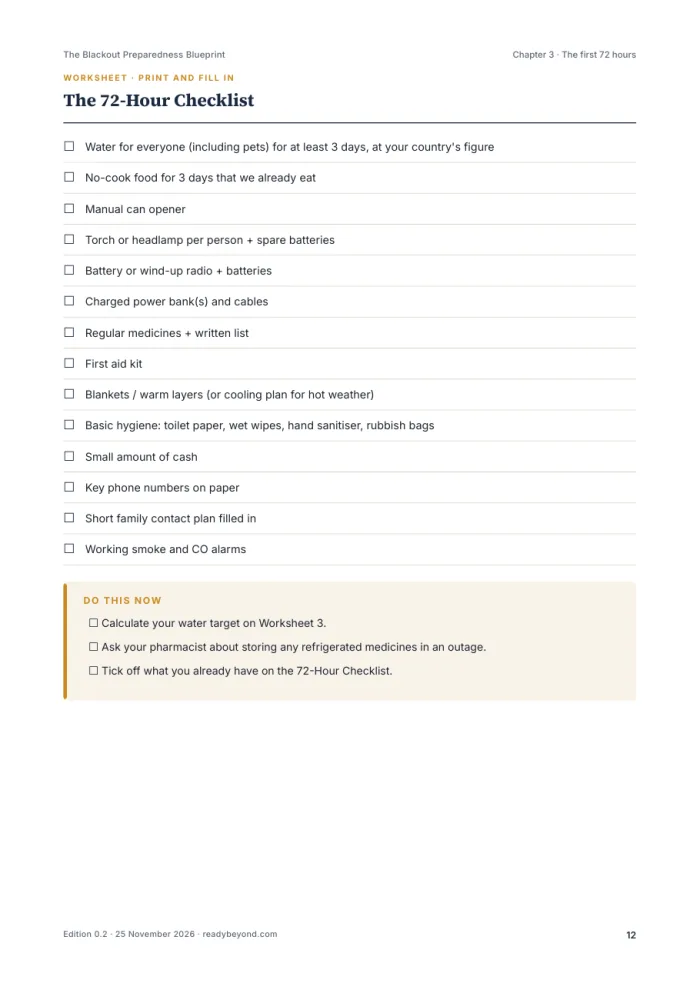
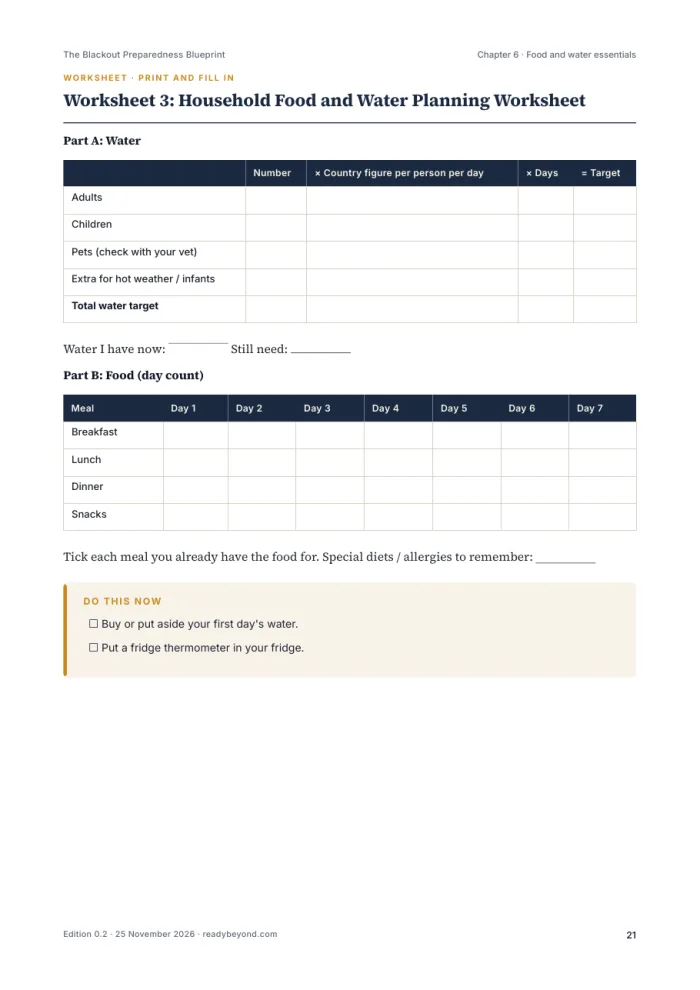
And because a PDF on a flat phone is no help to anyone, the most important pages are designed to be printed: the checklist, the worksheets, the fridge sheet and the page for your country.
ReadyBeyond is an independent publisher. We didn't invent new safety rules. We started from official emergency-management, public-health, food-safety and fire-safety guidance in five countries, then did the work most people never have time for: we sorted it, put it in order and turned it into steps and checklists a household can actually follow.
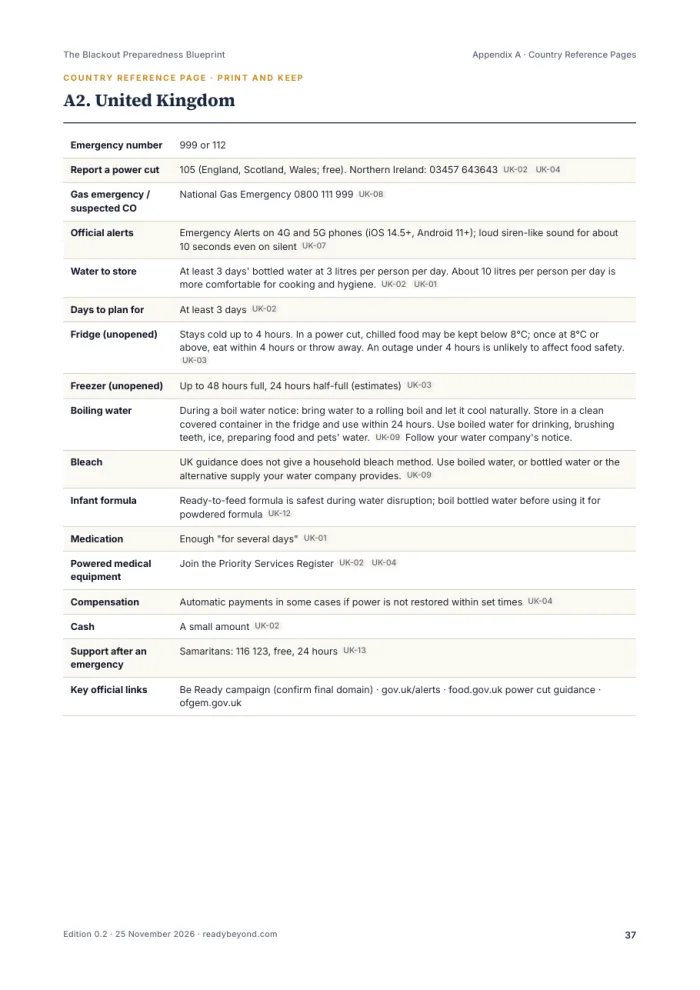
Where the official advice differs between countries (how much water to store, how long food stays safe in a fridge without power, how to treat water, which number to call), we don't give you one number that might be wrong where you live. We give you the principle, and a Country Reference Page with the figures for your country.
Swipe to see more pages →
We had a three-hour outage in March and, for the first time, nobody panicked. My partner went straight to the fridge sheet and the kids already knew where the torches were.
My dad uses oxygen at home. The Blueprint finally got me to register him with the power company and write down a proper backup plan. That alone was worth it.
I live in a small flat and assumed this wasn't for me. The apartment chapter was the most useful part, and I did the 7-day challenge over a week of evenings.
Here's a small part of what's inside:
Low-ink versions of the worksheets are included, so printing them at home won't empty your cartridge.
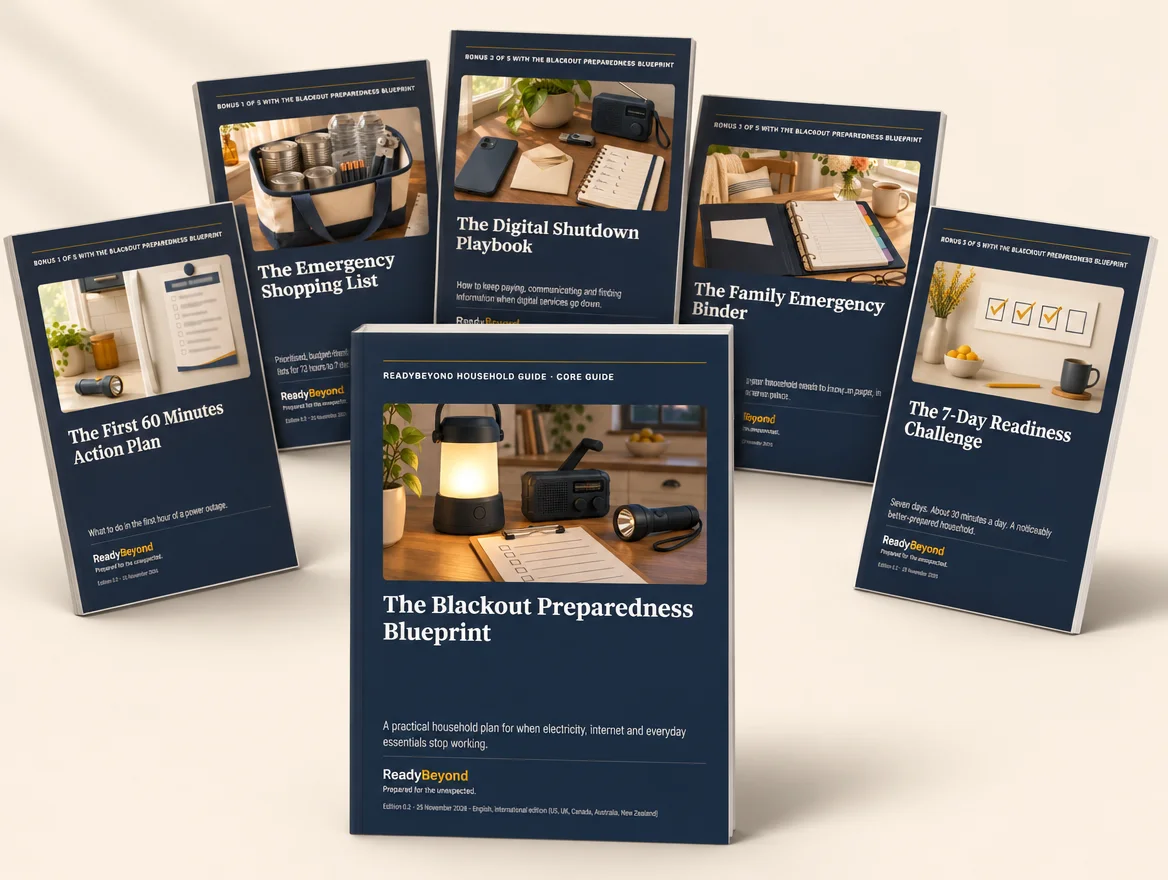
When you get the Blueprint today, you also get five companion PDFs. Each one turns a part of the plan into something you can print, fill in or follow.
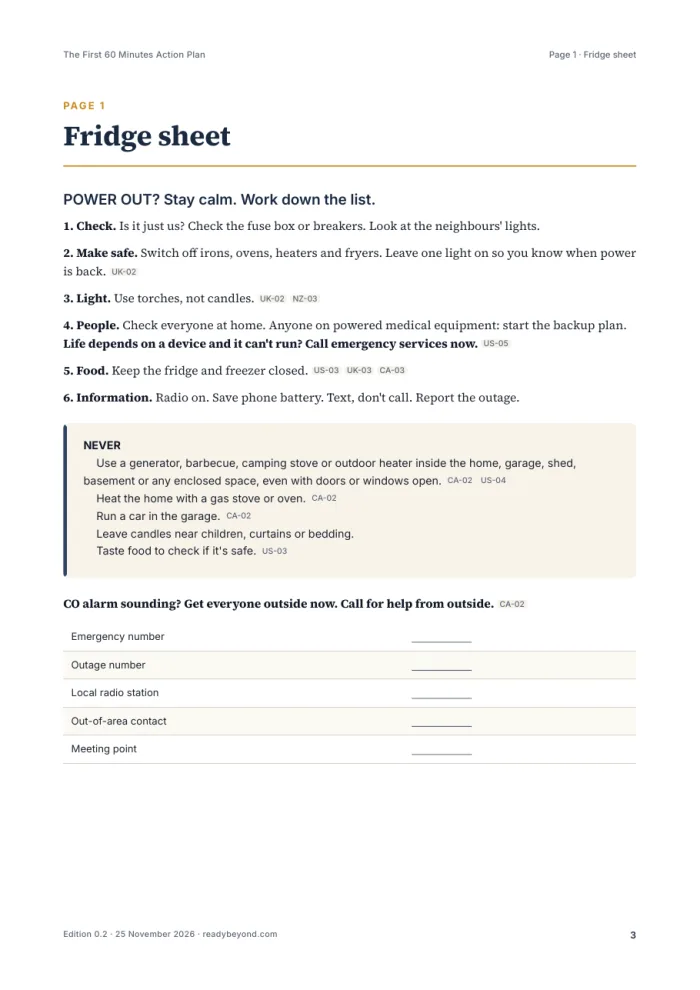
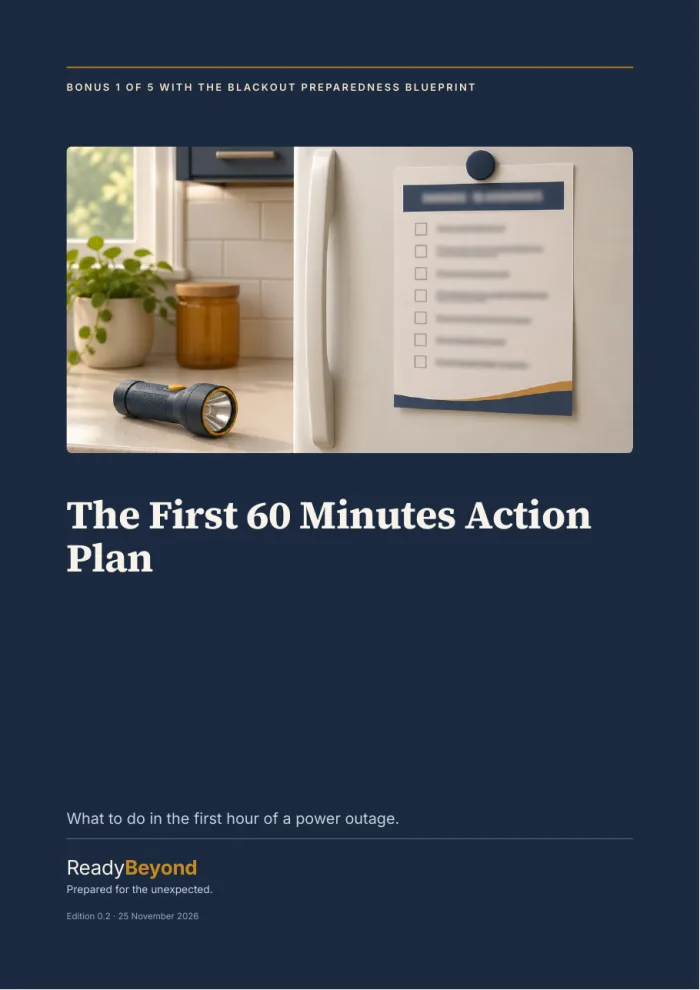
What to do in the first hour of a power outage, in order, minute by minute. Includes the one-page fridge sheet: large type, low ink, with a "never do this" box and spaces for your emergency number, outage line, local radio station and meeting point. When the lights go out, nobody has to think. They just work down the list.
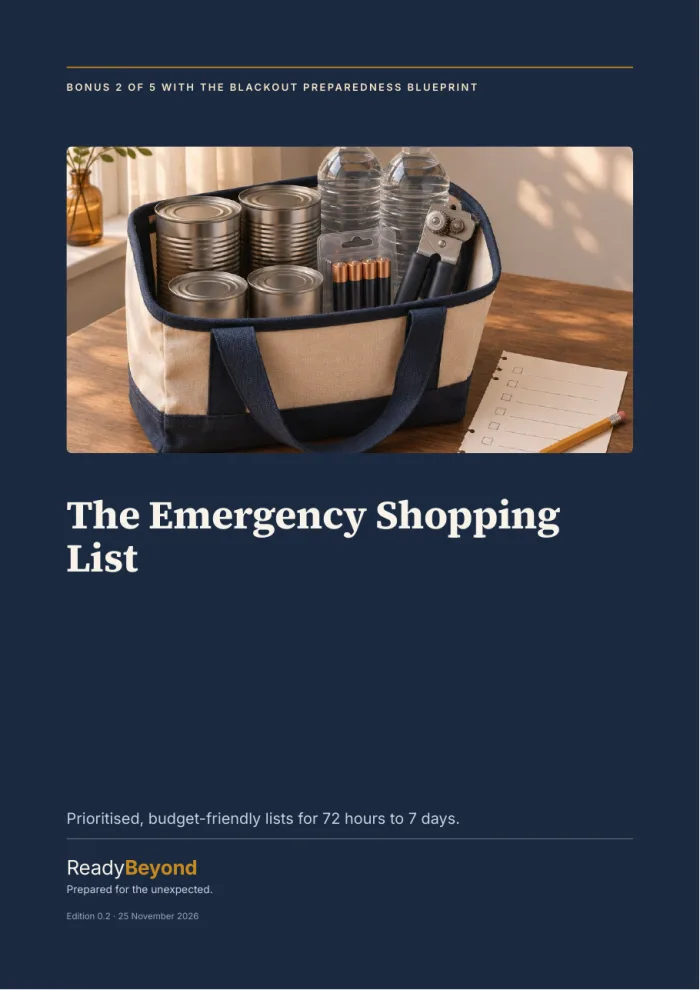
What to buy, in what order. Must-haves first (safety and health), then comfort, then nice-to-haves. Three kits with quantities (Starter, Standard and Extended, from 72 hours to 7 days) and how to adjust them for your household. You'll also see which things you can skip: survival kits full of items you won't use, "emergency" food at premium prices, uncertified power banks, and generators you couldn't run safely where you live. Everything on the list is available from a supermarket, hardware store or pharmacy.
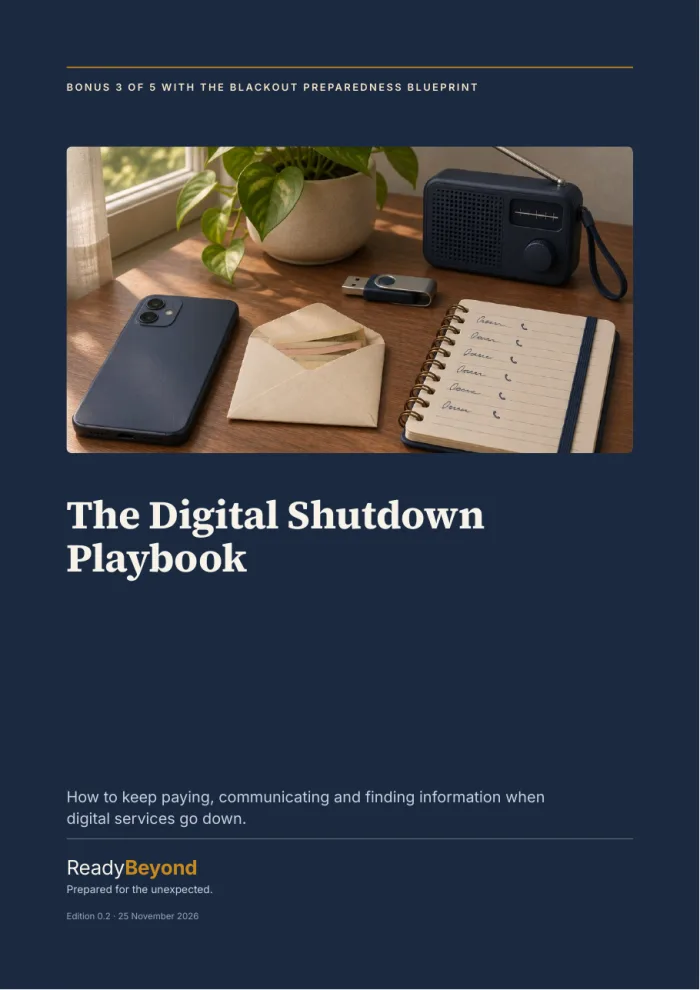
Most of us pay, bank, navigate and keep in touch through services that need electricity and the internet. They're usually very reliable. This playbook helps you get by calmly on the days they aren't: an emergency cash plan, payment and banking backups, offline maps, secure copies of your documents, other ways to communicate, and a check-in plan for the family. It includes an accounts recovery register that deliberately has no space for passwords, so your information stays safe.
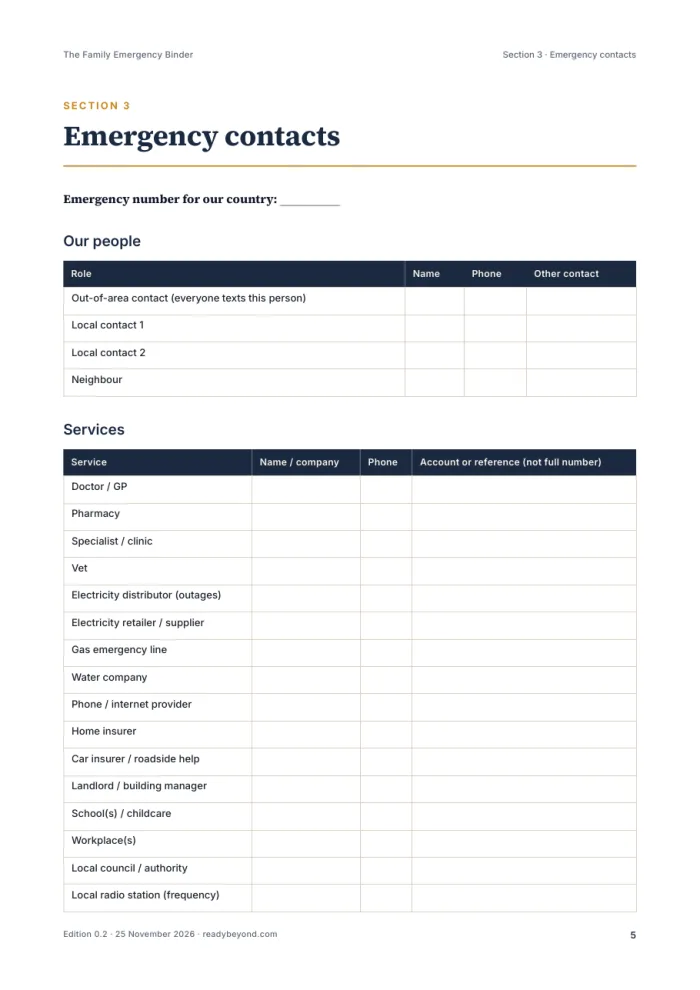
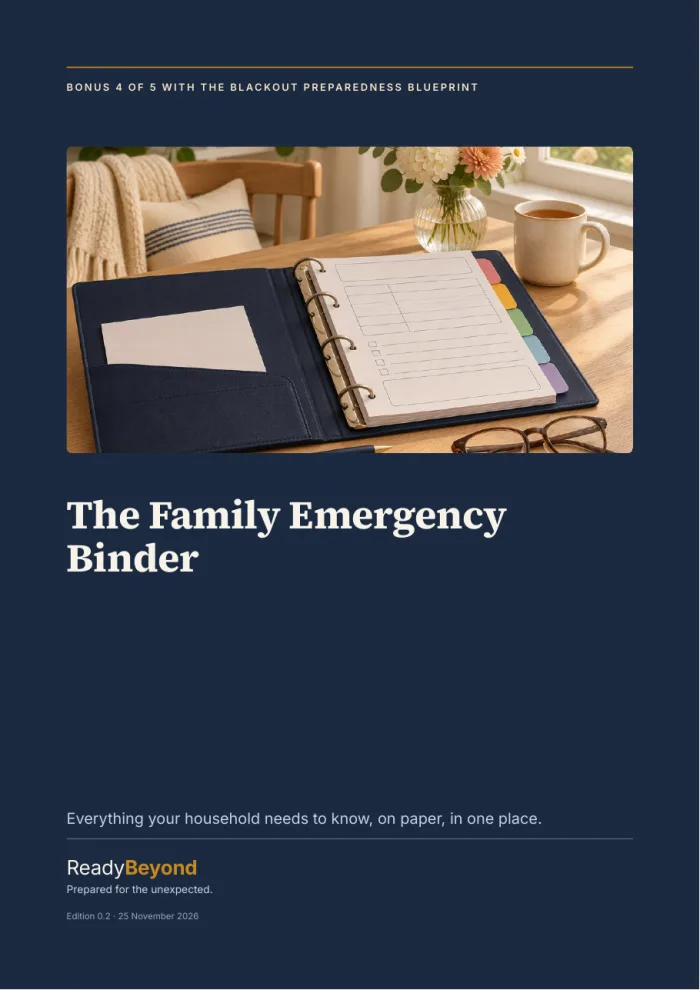
The pages you fill in once and keep: household members, emergency contacts, meeting points, a medication and medical information page for each person, arrangements for children and pets, your evacuation plan, a document checklist, your neighbour and support network, and a review log. With clear guidance on what to write down, what never to write down, and where to keep it securely.
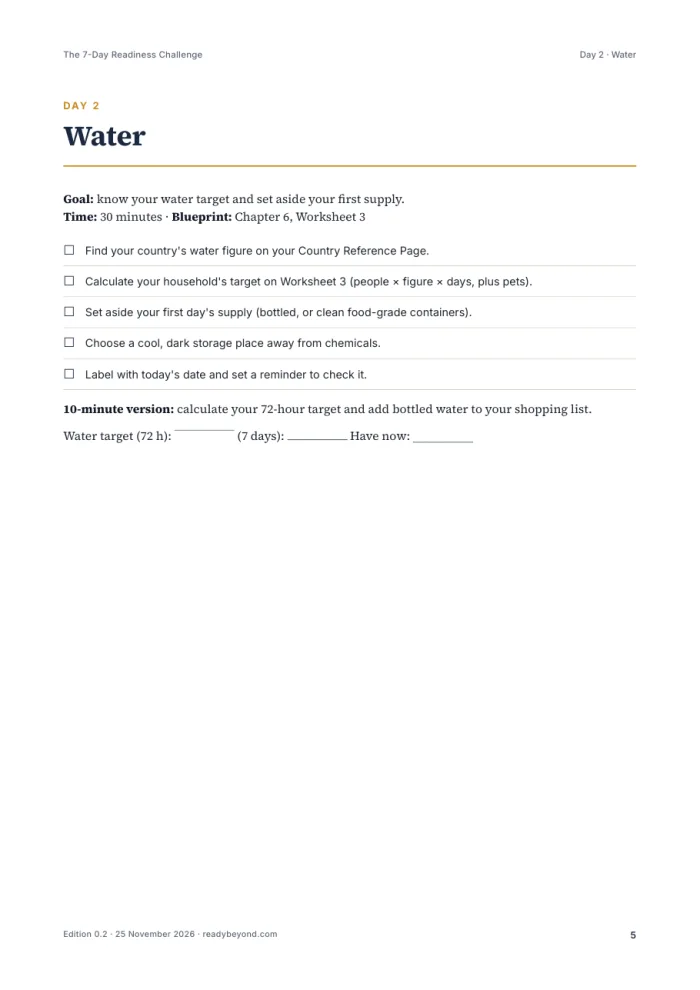
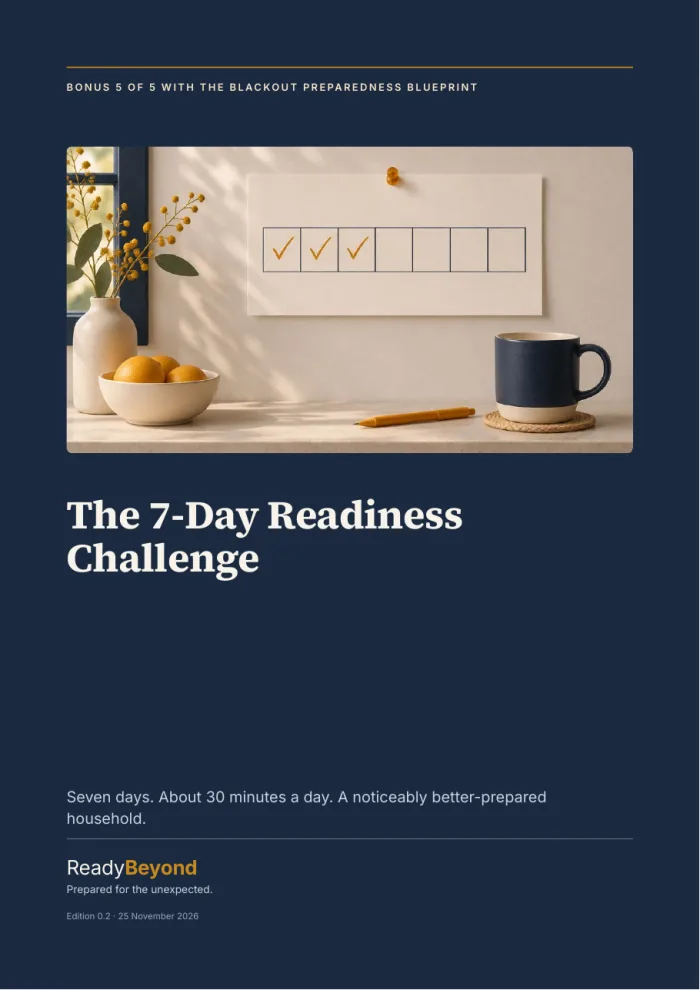
The bonus that gets it done. Seven days, about 30 minutes a day, one focus each day:
Every day has checkboxes, notes lines and a 10-minute version for busy days, plus a completion tracker. By the end of the week, your plan is on paper and your household knows it.
6 PDFs · over 100 printable pages · A4 and US Letter · low-ink worksheet packs
That's less than many households spend on a single "emergency kit" from a shop, and it tells you exactly what you actually need, so you don't buy the wrong one.
Get the Blackout Preparedness BlueprintInstant download · Read on your phone, tablet or computer · Print at home
How you get it. As soon as your payment goes through, you'll get an email with access to all six PDFs. Download them, save them, and print the pages you want to keep handy. Nothing is posted, so there are no shipping costs and no waiting.
What you need. Any phone, tablet or computer that opens PDFs. A printer is useful but not essential. You don't need to buy any equipment to get started.
Read the Blueprint. Do Day 1 of the 7-Day Readiness Challenge. If you don't feel it's worth far more than you paid, ask for a full refund within 30 days through Hotmart. No questions, no hassle.
No. The Blueprint starts with what you already have. The Emergency Shopping List shows you what to buy first, what can wait and what to skip, and the Budget Planner helps you spread the cost over time. Most of it is everyday stuff from the supermarket or hardware store.
The Blueprint is written for households in the United States, the United Kingdom, Canada, Australia and New Zealand. The general plan works anywhere. Figures that differ between countries, like water quantities, food-safety times, water treatment and emergency numbers, are on a separate Country Reference Page for each of the five countries. Where advice differs by state or province, the guide tells you where to check locally.
Yes, once you've downloaded and printed it. That's the whole idea. During an outage your phone may be flat or the internet may be down, so we recommend printing the Readiness Checklist, your Country Reference Page and the First 60 Minutes fridge sheet, and keeping them somewhere everyone can find them.
Yes. Every PDF comes in A4 and US Letter. The worksheets also come in low-ink versions for home printers.
No. These are digital PDFs you download straight away. Nothing is posted to you.
Not really. It's a household plan for ordinary disruptions: power outages, storms, heatwaves, and a few days without the usual services. There's nothing about bunkers, weapons or living off-grid.
You can read the first two chapters and fill in your family contact plan in an evening. The 7-Day Readiness Challenge takes about 30 minutes a day for a week. After that, you'll top things up now and then.
Yes. There's a whole chapter on small spaces and rentals: storage ideas, how renters can prepare without changing the property, and what to know if your building's water or lifts depend on electricity.
No. The Blueprint helps you plan around medicines and medical equipment, and it tells you when to talk to your doctor, pharmacist or energy company. It never asks you to change a medicine or a dose.
No. ReadyBeyond is an independent publisher. The guides draw on official public guidance from all five countries, and they always tell you to follow official instructions first in an emergency.
No guide can promise that, and you should be wary of any that does. Preparing makes disruptions easier to handle and helps you make better decisions under pressure. It doesn't remove risk. In an emergency, always follow official instructions.
At checkout you can add one optional extra, The 30-Day Emergency Pantry, for US$9. After your purchase you'll see one more optional offer. You don't need either. The Blueprint and its five bonuses are complete on their own.
The price is US$27. Your checkout may show the amount in your local currency.
You're covered by the 30-day money-back guarantee. Ask for a refund through Hotmart and you'll get your money back.
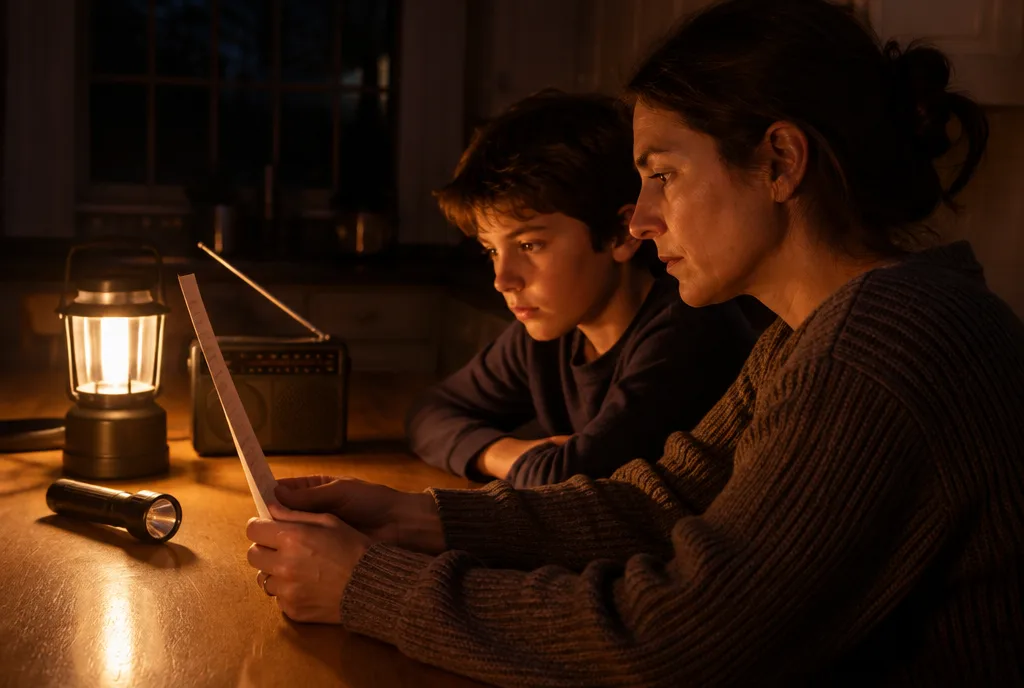
Most power outages are short. Most are a nuisance rather than an emergency.
But the next one will still go better if your household already knows what to do: where the torch is, what to do about the fridge, who calls whom, and what's on the sheet by the door.
US$27 · 6 printable PDFs · Instant download · 30-day money-back guarantee
P.S. If you only do one thing today, print the First 60 Minutes fridge sheet and put it on the fridge. It takes five minutes, and it's the page you'll be glad you have the next time the lights go out.
P.P.S. Prepared, not paranoid. No scare tactics, no doomsday predictions, no survival gear to sell you. Just a calm, practical plan for your household, built from official guidance and put in an order you can follow.